UiS has strengthened its collaboration with Laerdal Medical. One of the projects aims to make emergency calls to 113 (999/911 in Norway) easier to handle using artificial intelligence (AI).
Department of Electrical Engineering and Computer Science at University of Stavanger (UiS) has recently strengthened its collaboration with Laerdal Medical. Two new agreements have been signed for the next three years. In total, Laerdal is contributing NOK 3 million to research within health technology.
One of the projects benefiting from the collaboration agreement is led by Øyvind Meinich-Bache, Adjunct Associate Professor at UiS and Senior Data Scientist at Laerdal Medical. He works with signal, image and video processing and analysis.
Meinich-Bache’s project “AI in Chain of Survival” (AiCOS) is related to artificial intelligence and emergency medical communication. Analysis of words, voice direction and emotional state of the caller will help emergency medical operators identify the incidents more precisely. The goal is to make it easier for operators to guide and provide life-saving responses in stressful situations. Understanding language, emotions and cognition through AI-powered speech analysis enables more accurate and effective care.
“Research has shown that the greatest opportunity to save lives in time-critical emergencies lies in the first stages, before ambulance personnel arrive on the scene. What the caller and the emergency centres do together plays an important role,” says Meinich-Bache.
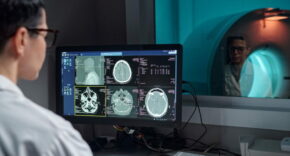
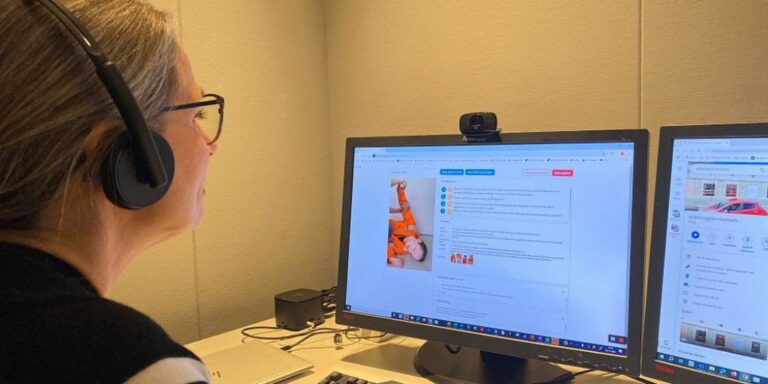
Professor Kjersti ENgan from the University of Stavanger illustrates how it can look on the screen when the AiCOS functionality is used.
More focus on the person
The emergency control centres are receiving an increasing number of calls. At the same time, the use of video calls has become more common. This means that the employees at the alarm centre have more to pay attention to. They must interpret both what is said and what they see on the screen.
“The functionality of our system is speech-to-text to understand what is being said, and image analysis of the video stream from the caller’s phone. The system interprets the patient’s symptoms, and provides medical advice based on the protocol used by emergency operators. This means that the person receiving the call can focus more on the caller and the dialogue. It becomes easier to make decisions about what is urgent, and what kind of help should be given to the patient,” says Meinich-Bache.
Other research areas covered by the collaboration agreement between UiS and Laerdal are artificial intelligence and empathetic communication between patient and healthcare worker, and signal processing to support the stabilization of newborns with breathing difficulties.