London, United Kingdom, 2026 – Heidi, the AI Care Partner used in more than 2.5 million patient interactions every week, today announced the UK launch of Heidi Remote, a purpose-built tool that gives clinicians reliable audio capture in NHS and other UK care settings without relying on a phone or a laptop.
In the UK, NHS teams are under sustained pressure from workforce shortages, rising demand and administrative burden. Heidi Remote is designed to help clinicians use AI scribing more accurately and effectively. It supports a shift away from informal bring-your-own-device (BYOD) workarounds towards governed, clinical‑grade audio capture that reflects updated NHS England BYOD guidance. By reducing time spent on documentation and limiting the need for personal devices in the consult room, Heidi Remote helps clinicians maintain more natural, face‑to‑face interactions with patients.
Remote marks Heidi’s first move into hardware, and a significant step in its evolution beyond documentation. It follows the recent release of Heidi Evidence, which surfaces high-quality medical research at the point of care, and Heidi Comms, which coordinates patient communications across calls, bookings, reminders, and follow-ups. Together, these products reflect Heidi’s broader vision: a clinical workflow where AI is the connective tissue between capturing, structuring, and communicating, freeing clinicians to focus on what they trained for, and what matters most delivering patient care.
The tools in most clinical environments were not built for this moment. Ageing computer terminals, shared workstations, and personal smartphones pressed into service were never designed to support AI-assisted care. As clinical AI has advanced rapidly, the hardware layer has not. The result is a growing mismatch between what’s now possible and what the infrastructure in most consult rooms, theatres and wards can actually support.
Clinical environments are also among the most demanding physical settings for any technology. Hospitals are inherently noisy and in emergency departments alone, peak noise levels have been recorded above 100 dB, comparable to a construction site. Tools face regular cleaning with hospital-grade disinfectants, constant handling across long shifts, and the need to perform reliably from first appointment to last. The consumer hardware that clinicians have been relying on was never built to those standards. A new standard of care requires a new generation of hardware.
The rise of AI scribes in clinical settings
AI scribing has become central to many clinicians’ workflows with Heidi having supported over 115 million sessions in 18 months, yet clinical environments were never designed for AI listening. Ambient noise, interruptions, and variable room acoustics can lead to missed words and dropped context, leading to degraded note quality. Heidi Remote solves this by providing a dedicated microphone directly to the clinician, ensuring consistent, high-quality audio capture, regardless of room conditions.
The launch of Remote complements Heidi’s AI scribe, which is having a real-world impact on global healthcare systems. A research report by Modality Partnership found that it halves the time GPs spend on paperwork, and 78% reported lower cognitive load and improved focus. This time can be redirected to improving patient care. Heidi Remote is designed to protect and extend those productivity gains by ensuring capture quality holds up across every clinical setting.
Dr. Thomas Kelly, Co-founder and CEO, Heidi, said: “AI scribing has transformed how clinicians manage documentation, but the weakest link has always been the tool in the room. A phone propped on a desk, a laptop left open, a dropped connection in a rural clinic. These aren’t edge cases; they’re daily realities for thousands of clinicians. Heidi Remote closes that gap. It’s a purpose-built tool that fits into the way clinicians already work, so the technology matches the standard of care they’re trying to deliver.”
Technology challenges in modern healthcare – and what comes next
The consult room is changing. AI scribing is fast becoming a standard part of clinical practice, and as adoption grows, so do expectations: for reliability, security, and seamless integration into clinical workflows. The question is no longer whether AI belongs in the consult room, but whether the hardware around it is ready to keep up. When a clinician relies on a personal device as their primary capture tool, the consultation dynamic shifts in ways that matter: a screen between patient and clinician, at exactly the moment trust is being built.
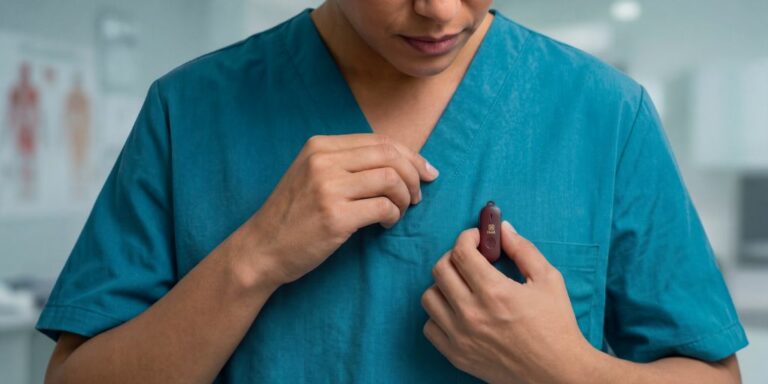
Heidi Remote is built for that moment. A high-quality wearable microphone engineered for reliable voice capture in demanding environments, it gives clinicians a dedicated tool for audio capture that works independently of phone battery or Wi-Fi connectivity. Key benefits of Heidi Remote include:
-
More consistent transcription quality: It captures speech clearly and reduces variability caused by room acoustics, background noise or movement, resulting in more accurate notes.
-
Lower cognitive load: Designed to clip onto everyday clinical attire, the tool removes the need to think about phone placement or manage a laptop during a consult.
-
Built for full clinical days: Weighing just 21g, Heidi Remote is lightweight and comfortable enough to wear from first appointment to last, with up to 14 hours of battery life.
-
Available online and offline: Consults are captured even without Wi-Fi connectivity, syncing automatically when a connection is restored.
-
Hygienic and secure: Designed for frequent cleaning and built to healthcare security standards, with all data encrypted.
-
Accessible pricing: Heidi Remote is priced to be within reach for individual clinicians and practices of all sizes.
The availability of Heidi Remote and other Heidi products and features referred to in this release may vary by market and is subject to the applicable legal and regulatory requirements in each jurisdiction.